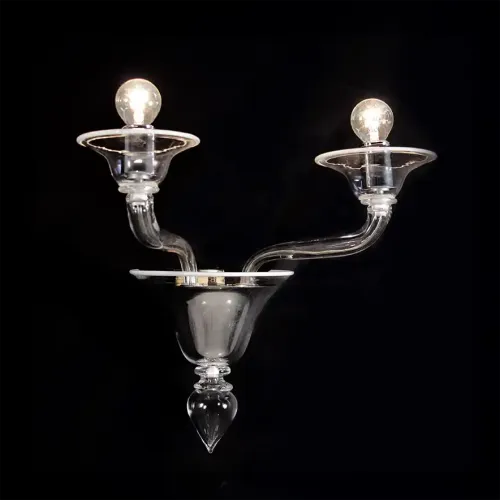
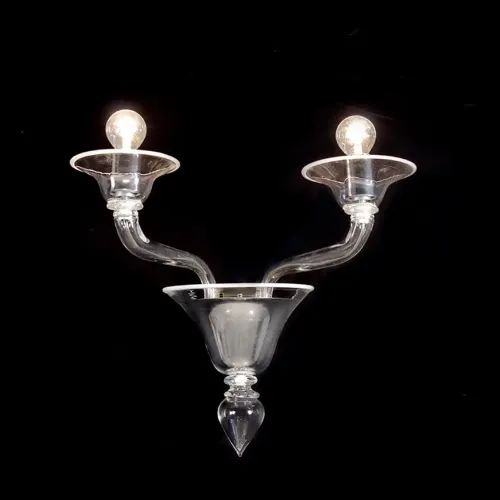
Description
Wall sconce handcrafted by Murano masters, rediscovering the history of Venetian glass art traditions with the precision and attention to detail that sets us apart.
Every step of the workmanship is handcrafted, and the wall sconce you order will be made expressly for your home.
Comes with Belvetro Murano Certificate of Guarantee and Authenticity.
Each wall sconce is shipped with included replacement parts and assembly instructions for quick and easy assembly.
Delivery is in 30-40 days by 100% insured express courier.
Would you like more information? Don’t hesitate to contact us, we will be happy to help you choose your Murano object, a value that lasts.
Church of San Gregorio (Venice)
The former church of San Gregorio is a deconsecrated religious building in Venice, located in the Dorsoduro sestiere.
Erected, it seems, in the early 9th century, in 989 it was submitted to the Benedictines ofSt. Hilary’s Abbey. Due to the latter’s decline, the following years saw a gradual move of the monks to St. Gregory’s, culminating in 1214, when it became the community’s main headquarters.
At the same time the church exercised parish functions, attested in a document from 1164, with priests appointed by the monks.
It was originally affiliated with the church of Santa Maria Zobenigo so that the parish priest was obliged to go to the matrix on Holy Saturday to attend the blessing of the baptismal font, receiving its holy water.
Reduced to commendation in 1450, the abbey went through a long period of both economic and spiritual decline that ended with the suppression of the monastery in 1775. The church briefly retained its role as a parish church, but was closed to worship in 1808 under Napoleon and its jurisdiction passed to Santa Maria del Rosario (vulgo Gesuati).
While the monastery buildings were being used for housing, the church was occupied by a Mint workshop for refininggold. After restoration in 1959-60, it was used as a restoration laboratory of the Superintendence for Artistic and Historical Heritage of Venice. Today it has long been disused.
The gabled facade is tripartite with four pilasters. In the center is the portal, enclosed by an elegant rosette frame, and, just above, the large rose window. The fullness of the exposed brickwork is relieved by two overlapping mullioned windows on each side.
Inside, with a single nave, remnants of frescoes still survive. The three apses with trussed ceilings are interesting.